
WELCOME BONUS 300%
UP TO €2000 + 100
FREE SPINS
UP TO €2000 + 100
FREE SPINS
Home → Blackjack
Blackjack at Mega Frenzy Casino: Variants, Rules and Payouts
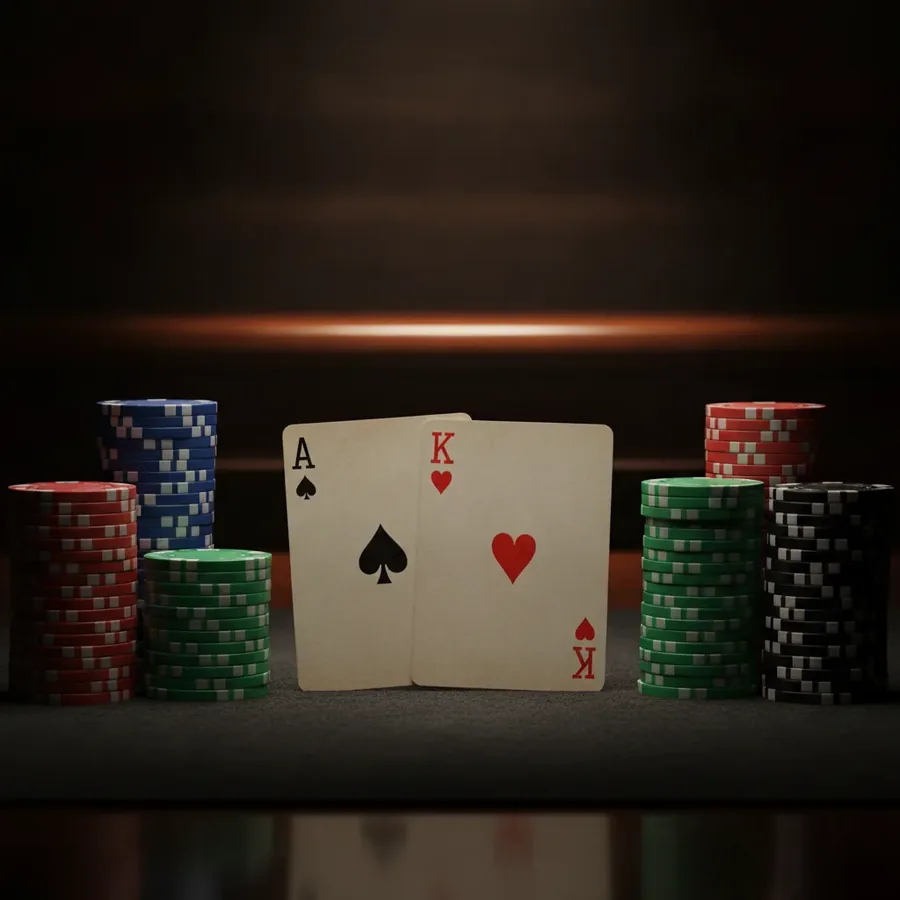
Splitting Eights vs Standing on 16
Blackjack Liberal Vegas Strip carries an RTP of 99.72% and a house edge of 0.28%, and its rule set allows resplitting, which turns a starting pair of eights into two separate hands instead of one weak total. Standing on 16 against a dealer ten keeps that hand at a single stake, while splitting eights puts a second bet of the same size on the table. On a €10 bet, standing risks €10 on one card draw; splitting commits €20 across two hands that each start from eight, so the decision is measured in doubled exposure, not in a better single card.
Blackjack Single deck, classic rules, 3:2 returns 99.85% with a house edge of 0.15%, the lowest edge in this comparison, and one deck gives about −0.48 percentage points compared with eight decks. A player who stands on 16 avoids the extra stake but keeps a hand that loses to any dealer total of 17 or more, while a split eight creates two chances at 18 or better. The single-deck figure is often offset by a 6:5 payout, which pays €12 on a €10 blackjack instead of €15.
Blackjack 6 decks, S17, DAS, DOA, 3:2 payout, basic strategy reaches 99.54% RTP with a house edge of 0.46%, and the split rule there allows up to four hands, so a pair of eights can become four separate stakes of €10 each. That is €40 committed on one round, and each hand needs its own decision under basic strategy. Doubling after a split improves the return by about 0.14 percentage points, which is a small compensation for the additional money at risk on the split itself.
The Insurance Mistake: 7% Extra House Edge
Blackjack Insurance on six to eight decks runs at 92.53% RTP with a house edge of 7.47%, and it is a separate side bet of up to 50% of the main bet, taken only when the dealer shows an ace. On a €10 main bet the insurance stake can be €5, and it pays 2:1 when the dealer holds a ten-value card underneath. The main game on six decks sits at a 0.46% house edge, so insurance multiplies the cost of that round by roughly sixteen times.
Defining the term: the house edge is the average share of each stake that the casino keeps over the long run, and 7.47% means that €100 of insurance stakes cost €7.47 on average. Basic strategy always declines the insurance bet, with the only exception being card counters at a true count of +3 or higher. A single-deck version lowers the edge to about 5.88%, still far above the 0.28% of Blackjack Liberal Vegas Strip.
Blackjack Surrender, played as late surrender, returns 50% of the stake after the dealer has checked for blackjack and improves RTP by about 0.08 percentage points, while early surrender is worth up to −0.6 percentage points but is extremely rare. Both figures sit in a different order of magnitude from the 7.47% insurance edge, which is why the side bet is the costlier mistake. Declining insurance on every round keeps that 7.47% out of the player's results entirely.
Doubling After a Split: Which Tables Allow It
Blackjack 6 decks, S17, DAS, DOA, 3:2 payout, basic strategy names doubling after a split as part of its rule set, and that single rule improves the return by about 0.14 percentage points. Doubling means the stake is multiplied by two in exchange for exactly one more card, so a €10 hand becomes a €20 hand with no further decisions. The same table reaches 99.54% RTP with a house edge of 0.46% when basic strategy is followed.
Blackjack Liberal Vegas Strip applies S17, DAS, resplit and late surrender together, and its 99.72% RTP with a 0.28% house edge reflects the full package. Removing doubling after a split from that combination would cost roughly the 0.14 percentage points the rule is worth, moving the edge toward 0.42%. Resplitting aces improves the return by 0.08 percentage points, a smaller gain than the doubling rule.
Dealer behaviour matters as much as the split rule: hitting soft 17 lowers RTP by 0.22 percentage points, which is more than the 0.14 points that doubling after a split adds back. Six decks instead of eight is worth only about 0.02 percentage points, the smallest effect in the group. A table that offers DAS but hits soft 17 therefore gives back more than it grants, and the net effect is a higher house edge than the headline rule suggests.
Six to Eight Decks in the Shoe
Blackjack Single deck, classic rules, 3:2 shows what deck count does at the extreme: 99.85% RTP and a 0.15% house edge, with one deck giving about −0.48 percentage points compared with eight decks. Moving from six decks to eight decks changes the edge by only about 0.02 percentage points, a fraction of that single-deck advantage. The six-deck benchmark is 99.54% RTP with a 0.46% house edge, so the eight-deck version lands near 0.48%.
The 3:2 payout pays €15 on a €10 blackjack, while 6:5 pays only €12, and replacing 3:2 with 6:5 adds exactly +1.39 percentage points to the casino's edge. That single change outweighs the entire deck-count effect by a factor of roughly seventy. Blackjack 6:5 on six decks drops to 98.15% RTP with a 1.85% house edge, so the shoe size is a minor variable next to the payout ratio.
On a €10 bet the difference between six and eight decks is about €0.02 per €100 staked, while the 6:5 payout costs €3 on every blackjack compared with 3:2. Insurance on six to eight decks carries a 7.47% house edge regardless of the exact shoe size. Deck count therefore sets the baseline, and the payout ratio and side bets decide what the round actually costs.
A Side Bet Every Round: The Budget Lasts 30 Rounds
Blackjack Insurance on six to eight decks returns 92.53% RTP with a 7.47% house edge, and staking the maximum 50% of the main bet on a €10 hand means €5 per round. Thirty rounds of that insurance at €5 each put €150 of side stakes on the table, of which about €11.21 is kept by the casino at the 7.47% edge. The main game on six decks at a 0.46% edge would keep only about €0.69 on the same €150.
Losing 50% of the stake on Blackjack Surrender returns €5 on a €10 hand, and the rule improves RTP by about 0.08 percentage points, a fraction of the insurance cost. Insurance pays 2:1, so a €5 stake returns €10 plus the €5 stake when it wins, but the 7.47% edge means those wins arrive too rarely to cover the outlay. Thirty rounds is where a modest budget stops stretching.
Quantum Blackjack Plus Live from Playtech covers a bet range of 1 - 5,000 EUR with a 99.57% RTP under optimal strategy, and Lightning Blackjack from Evolution spans 1 - 2,500 EUR at 99.56%. Both live tables keep the edge near 0.44%, so a budget spent on their main bets lasts far longer than one spent on insurance at 7.47%. The side bet is the single decision that shortens a session fastest.
Blackjack variants at a glance
| Variant | Payout | House edge | Rule | RTP |
|---|---|---|---|---|
| Blackjack Liberal Vegas Strip (liberal rules, 3:2) | Blackjack 3:2, win 1:1 | 0.28% | The most player-friendly rule set: S17 + DAS + resplit + late surrender. Standard deviation 1.15 | 99.72% |
| Blackjack Split / double / H17 – rule effects | Double – stake ×2 with one card; split – up to 4 hands; split aces usually get one card each. | H17 +0.22 percentage points; RSA −0.08 percentage points; DAS −0.14 percentage points | Dealer hitting soft 17 lowers RTP by 0.22 percentage points; resplitting aces improves it by 0.08 percentage points; doubling after a split improves it by about 0.14 percentage points; 6 decks instead of 8 – about 0.02 percentage points. | n/a (rule modifiers) |
| Blackjack 6:5 payout instead of 3:2 (6 decks) | Blackjack 6:5, win 1:1 | 1.85% | Replacing 3:2 with 6:5 adds exactly +1.39 percentage points to the casino's edge – more than any other rule change. On a €10 bet a blackjack pays €12 instead of €15. | 98.15% |
| Blackjack Insurance (6–8 decks) | Insurance 2:1 | 7.47% | Separate side bet of up to 50% of the main bet when the dealer shows an ace. Basic strategy ALWAYS declines it (except for card counters at a true count ≥ +3). With a single deck the edge is ≈ 5.88% | 92.53% |
| Blackjack 6 decks, S17, DAS, DOA, 3:2 payout, basic strategy | Blackjack 3:2, regular win 1:1, insurance 2:1 | 0.46% | Dealer stands on soft 17; double down on any first two cards; doubling after a split allowed; no surrender. Basic strategy is required to reach this figure | 99.54% |
| Blackjack Surrender (late surrender) – rule effect | 50% of the stake returned | −0.08 percentage points | The player gives up the hand after the dealer has checked for blackjack and loses half the stake. Improves RTP by about 0.08 percentage points. Early surrender is worth much more (up to −0.6 percentage points) but is extremely rare. | n/a (rule modifier) |
Stand-on-17 Rule and Its Meaning for Players
Mega Frenzy Casino presents a blackjack variant with the dealer stands on soft 17 (S17) rule, offering an RTP of 99.54% and a house edge of 0.46% under basic strategy. The S17 rule means the dealer stops drawing cards with any hand totaling 17, including an ace counted as 11. This stands against a dealer hitting soft 17 (H17) rule, which raises the casino's edge by 0.22 percentage points.
S17, combined with doubling down on any first two cards and doubling after a split allowed, shapes the basic strategy table a player must follow to reach the 99.54% return. The no surrender rule means a bad hand cannot be given up early for half the stake, a small but measurable edge difference. The player's regular win pays 1:1, while a blackjack pays 3:2, equal to €15 on a €10 stake.
For comparison, the more liberal Vegas Strip rule set with S17, DAS, resplit and late surrender shows an RTP of 99.72% and a house edge of 0.28%. The 0.18 percentage point difference between the standard S17 game and the Liberal Vegas Strip comes mostly from surrender and resplit options. A player staking €100 per round can expect to lose €0.46 on average in the S17 game versus €0.28 in the liberal set.
Splitting at a Live Table, Step by Step
A split in Mega Frenzy Casino's standard blackjack allows up to four hands, with doubling after a split permitted, and resplitting aces improving RTP by 0.08 percentage points. The procedure begins when the player holds two cards of the same rank. The initial stake is duplicated, and the pair is separated into two hands. Each hand is then played individually, receiving additional cards as needed.
Doubling after a split affects the house edge by −0.14 percentage points, meaning the player's return improves when the option exists. A double places a second stake equal to the original on that hand, and the player receives exactly one card. In the split aces scenario, aces usually receive one card each, limiting the possibility of drawing a ten and forming a soft hand improvement.
Blackjack Party by Evolution, with a bet range of €1 to €1,000, and Lightning Blackjack, with a bet range of €1 to €2,500, both allow an unlimited number of players at one table. The split rule also appears in Quantum Blackjack Plus Live by Playtech, where the bet range spans €1 to €5,000. A split hand that then wins pays 1:1 on each separate stake, while a natural blackjack formed after a split is not standard.
When Can You Raise Your Bet?
A player can raise the wager with a double down on any first two cards in Mega Frenzy Casino's standard blackjack, a rule that retains the 99.54% RTP with basic strategy. Doubling after a split is also allowed, lowering the house edge by 0.14 percentage points. This means after splitting a pair, a strong two-card total can be doubled for an additional stake equal to the original.
The double down stake multiplies the original bet by two, and only one further card is dealt. In Quantum Blackjack Plus Live by Playtech, the same move is available within a bet range of €1 to €5,000. In Lightning Blackjack by Evolution, the range is €1 to €2,500. A €50 initial wager doubled to €100 that wins at 1:1 returns €200 in total.
Insurance is a separate side bet of up to 50% of the main wager when the dealer shows an ace, but it carries a house edge of 7.47% in 6–8 deck games. Basic strategy always declines insurance, except for card counters at a true count of +3 or higher. A €100 main bet with a €50 insurance wager pays 2:1, but the average loss on the insurance alone is €3.74 per hundred in stake.
Side Bets Raise the House Edge to 5%
Insurance in the standard 6–8 deck blackjack at Mega Frenzy Casino carries a house edge of 7.47% and an RTP of 92.53%, far worse than the main game's 0.46% edge. The side bet is available when the dealer shows an ace, and the player may stake up to 50% of the original wager. A winning insurance bet pays 2:1, so a €10 side bet returns €30.
The 6:5 blackjack payout is another variant that shifts the edge upward, producing an RTP of 98.15% and a house edge of 1.85%. Replacing the 3:2 payout with 6:5 adds exactly 1.39 percentage points to the casino's edge, more than any other rule change. On a €10 bet, a blackjack pays €12 instead of €15 under the 6:5 rule.
Combining multiple unfavorable side rules can push a player's average loss far beyond the base game. The standard 3:2 game keeps €0.46 per €100 staked, while the 6:5 variant keeps €1.85 per €100. If a player also takes insurance regularly, the 7.47% edge on that separate stake compounds the total loss, moving the overall figure toward the high single digits.
Surrender or Play On With 16 Against a 10
Late surrender in blackjack allows the player to give up a hand after the dealer has checked for blackjack, losing half the stake. The Liberal Vegas Strip rule set, which includes late surrender, shows an RTP of 99.72% and a house edge of 0.28%. The surrender option alone improves RTP by about 0.08 percentage points compared to a game without it.
The standard S17 blackjack at Mega Frenzy Casino does not include surrender, so a player holding 16 against a dealer's 10 must play out the hand. The H17 rule effect adds 0.22 percentage points to the house edge, while RSA subtracts 0.08 and DAS subtracts 0.14. Without surrender, the player retains the original stake at risk rather than securing a 50% return.
Early surrender, which is extremely rare, can be worth up to −0.6 percentage points of house edge, far more than late surrender. In the 3:2 payout standard game, a €100 hand surrendered late returns €50, while a played-out loss costs the full €100. The difference of €50 per hand explains why the option exists in the liberal rule set but not in the standard game.
No Doubling Down on Three Cards
Blackjack rules limit doubling down to the first two cards, so a three-card hand cannot double. The six-deck variant with S17, DAS, DOA and a 3:2 payout carries an RTP of 99.54% and a house edge of 0.46%, a figure that assumes basic strategy and doubling on any first two cards, not on later hands.
The rule matters because doubling after a split, worth about 0.14 percentage points of house edge, applies only when the split hand still holds two cards. A three-card total is simply played out with a hit or a stand. Insurance pays 2:1 on a side bet, yet basic strategy always declines it.
Compared with the liberal Vegas Strip rule set at 99.72% RTP and a 0.28% house edge, the six-deck game gives up 0.18 percentage points of return. On €100 of stakes that difference costs about €0.18 on average, so the three-card restriction is a minor leak next to a 6:5 payout, which raises the edge to 1.85%.
Which Rule Variants the Software Shows
Blackjack in the software appears in several rule sets, and the payout ratio separates them most sharply: a 3:2 blackjack pays 150 EUR on a 100 EUR stake, while the 6:5 variant pays only 120 EUR on the same 100 EUR. That 30 EUR gap per blackjack is not cosmetic, because replacing 3:2 with 6:5 adds exactly 1.39 percentage points to the house edge, which is the average share of each stake the casino keeps. The 6:5 game therefore carries an RTP of 98.15% against 99.54% for the 6-deck, S17, DAS, DOA game at 3:2.
The liberal Vegas Strip rule set is the most player-friendly of the group at an RTP of 99.72% and a house edge of 0.28%, built from S17, doubling after a split, resplitting and late surrender. Single deck with classic rules and a 3:2 payout reaches 99.85% and a house edge of 0.15%, because one deck is worth about 0.48 percentage points against eight decks. That advantage disappears if the same single-deck game pays 6:5 instead.
Rule modifiers move the figure in smaller steps: dealer hits on soft 17 lowers RTP by 0.22 percentage points, doubling after a split improves it by about 0.14 percentage points, resplitting aces by 0.08, and six decks instead of eight by roughly 0.02. Insurance is the exception, priced at an RTP of 92.53% with a house edge of 7.47%, so basic strategy always declines it. The 6-deck benchmark at 99.54% and 0.46% requires basic strategy to be reached.
Blackjack Party Has Two Hosts
Blackjack Party by Evolution runs with two hosts instead of the standard single dealer, setting a bet range of 1.00 to 1,000 EUR per hand. The format keeps the usual blackjack rules but shifts the table into a party-style presentation with two presenters managing the game flow. A player buying in at 10 EUR per hand gets 100 rounds at the lower end before the 1,000 EUR cap is reached, which frames the table as accessible for casual stakes.
The two-host setup does not change the underlying return, but Evolution's blackjack tables of this type sit near the 99.56% RTP mark that Lightning Blackjack also carries under optimal play. For comparison, Quantum Blackjack Plus Live reaches 99.57% with its multiplier mechanics, while a standard six-deck game with dealer standing on soft 17 pays 99.54%. Across 100 EUR of stakes, that half-percent gap costs roughly 0.50 EUR on average against the best listed variant.
This table's 1,000 EUR upper limit is far below the 5,000 EUR ceiling on Quantum Blackjack Plus Live, making Blackjack Party the lower-risk option among live blackjack formats. With a 3:2 payout, a blackjack on a 100 EUR stake returns 150 EUR, while a 6:5 table would pay only 120 EUR for the same hand. The two hosts therefore add atmosphere without changing the core arithmetic of the game.
Contact
Live - online chat
Banking









Providers












Mega Frenzy Casino 2026